

Treatment illustration
At a glance
| Design detail | Why it belongs in the plan |
|---|---|
| Upper or lower arch | The evidence and recommendations differ |
| Implant count and distribution | Documents how the denture will be retained and supported |
| Individual attachments or bar | Identifies the components the care team will service |
| Fit and handling | Lets you check removal, stability and access for cleaning |
How the denture attaches
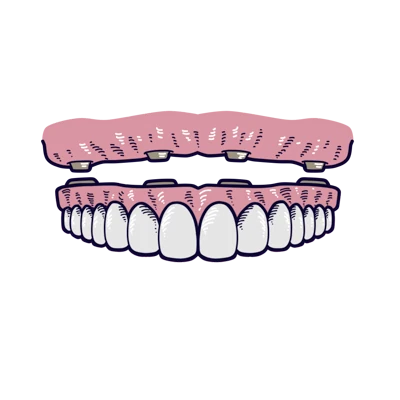
An overdenture can engage individual attachments or a bar linking implants. Ask to see where the denture is supported, how the attachments engage and which surfaces need cleaning. Being able to handle the denture and reach the attachments matters in daily use.

The lower-jaw evidence
The 2023 ITI consensus found better patient-reported outcomes with two implants retaining a lower overdenture than with one. In its review, more than two did not produce a further improvement in those reported outcomes. That result concerns how people assessed their dentures. It does not establish identical results for maintenance, implant loss or every attachment design.
The upper jaw has its own guidance
A 2026 upper-jaw consensus suggests at least four appropriately distributed implants for a maxillary overdenture to reduce implant failure. That is a different population and outcome from the lower-jaw comfort evidence. Ask the clinician how the proposed design addresses your available bone, support and ability to remove the denture.