

Treatment illustration
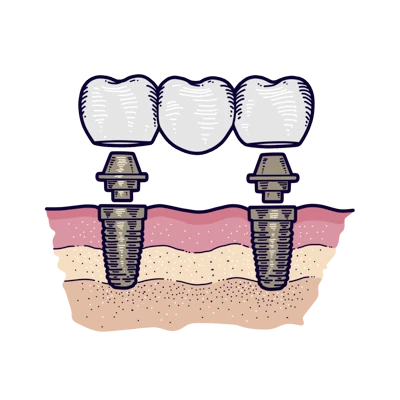
At a glance
| Plan term | Meaning |
|---|---|
| Three units | Three joined tooth positions |
| Two abutment implants | Two supporting implant fixtures |
| Pontic | An unsupported tooth unit within the span |
| Bridge fee | Check the prosthesis, abutments and fixtures separately |
Read the drawing from the gum upward
An implant-supported unit connects to a fixture through restorative components. A pontic is a tooth on the bridge with no implant directly beneath it. In a three-unit drawing, ask the clinician to mark which units have supports and where the bridge can be cleaned. A plan that simply lists “three implants” may represent a different reconstruction from a plan for three visible teeth on two supports.
What the clinical studies compared
Studies have examined three-unit restorations on two versus three implants and compared implant-supported with natural-tooth-supported bridges. In a matched retrospective study, 24 implant-supported cases were compared with 24 tooth-supported cases. At about four years of average follow-up, overall patient satisfaction showed no significant difference. The small groups and non-random treatment assignment limit the inference. The condition of the patient’s neighboring teeth remains an important decision variable.
Unpack the fee for the whole bridge
Ask how many implants and abutments are included, which material makes up the bridge and whether a temporary restoration is part of the price. A fee for a single implant-and-crown package cannot simply be multiplied by the number of visible teeth. A written drawing and itemized fee also give a future dentist a starting point if part of the bridge later needs attention.